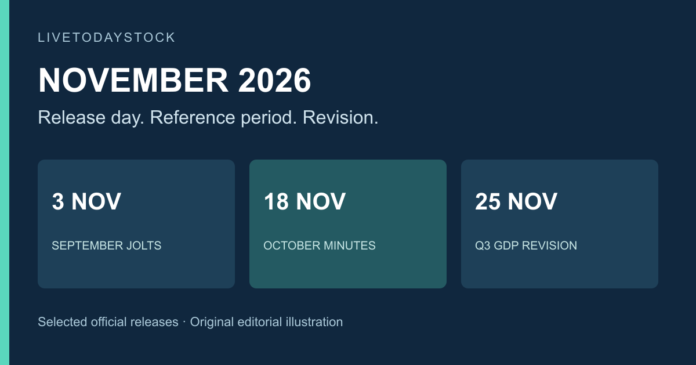

The first question for a November release is which period it describes. September job openings, October consumer prices and a second estimate of third-quarter GDP can all arrive in November. Treating them as a single snapshot of November conditions loses the information each release actually adds.
This selected U.S. economic calendar pairs official release dates with their reference periods and the comparison to prepare. It is not a forecast, a complete events feed or a claim about the direction of stocks.
Selected dates and the information each adds
| Release day | Official release | Reference period or meeting | Time and reading check |
|---|---|---|---|
| November 3 | BLS Job Openings and Labor Turnover Survey | September 2026 | 10:00 ET. Keep openings and turnover separate from the following employment release. |
| November 6 | BLS Employment Situation | October 2026 | 08:30 ET. Separate the new month from revisions to earlier months. |
| November 10 | BLS Consumer Price Index | October 2026 | 08:30 ET. Label monthly versus annual changes and the series being compared. |
| November 18 | FOMC minutes | October 27–28 meeting | 14:00 as displayed by the Board. No timezone label captured; no UTC conversion assigned here. |
| November 25 | BEA GDP second estimate and corporate profits | Third quarter 2026 | 13:30 UTC, directly specified by BEA. Compare GDP with the advance estimate for the same quarter. |
| November 25 | BEA Personal Income and Outlays | October 2026 | 13:30 UTC, directly specified by BEA. Same timestamp as GDP, different reference period and series. |
Dates and periods come from the BLS November calendar, Board November calendar and BEA release schedule. The BEA calendar subscription file gives both November 25 events as 13:30 UTC. The file’s UTC timestamp, rather than an assumed customary release hour, anchors those two rows.
November’s clock change
BLS explicitly labels its calendar Eastern Time. NIST lists November 1, 2026 as the end of U.S. daylight saving time. Eastern standard time is UTC−5, so the listed November BLS events at 08:30 ET convert to 13:30 UTC. The November 3 event at 10:00 ET converts to 15:00 UTC. Reusing an October daylight-time UTC offset would move the alert an hour early.
The checked Board entry gives 14:00 but does not establish the timezone. This article retains that display with the limitation instead of borrowing BLS’s timezone label. Confirm the event’s timing on the Board’s own page before setting an alert.
Five comparisons to prepare before a release
| If the headline says… | Record this separately | Why it changes the interpretation |
|---|---|---|
| Released in November | Reference month or quarter | A release month is not the period measured. |
| GDP second estimate | Advance and second estimates for the same Q3 | A revision changes the estimate of a period already reported. |
| Prior month revised | Old published value and newly revised value | A comparison against an obsolete prior value can misstate the change. |
| Fed minutes | Meeting date and minutes publication date | A meeting record is different from a new policy decision. |
| Two releases at 13:30 UTC | Separate source documents and reference periods | Sharing a timestamp does not make income, spending and GDP one measure. |
For example, the November 25 GDP row should be compared with the advance estimate scheduled for October 29, not described as a first estimate of Q4. At this article’s October 25 source cutoff, that October release is still ahead. No advance-estimate value or November revision is assumed here. The income-and-outlays row on November 25 describes October, not the same third quarter as GDP.
The FOMC meeting calendar schedules October 27–28 and then December 8–9. November 18 is the scheduled publication of the October meeting’s minutes, not a scheduled November rate decision. An unscheduled announcement is outside the scope of this calendar.
Keep the calendar separate from the result
Before each release, leave actual values and market reactions blank. After release, save the document date, reference period and revision status beside the reported figure. This gives a later review a reproducible starting point instead of a moving headline.
The site’s economic calendar tool can help track upcoming releases; official agency pages remain the authority for these dates. For completed company releases, our earnings-report reading guide addresses a separate reporting task. Neither link turns this selected macro calendar into a full earnings, analyst-rating or exchange-holiday schedule. Recheck the agency calendar before the event because schedules can change.
AI assisted the research and drafting. Publisher: LiveTodayStock Editorial Team. This calendar is not an investment recommendation. See contact details and our corrections policy to report an error.