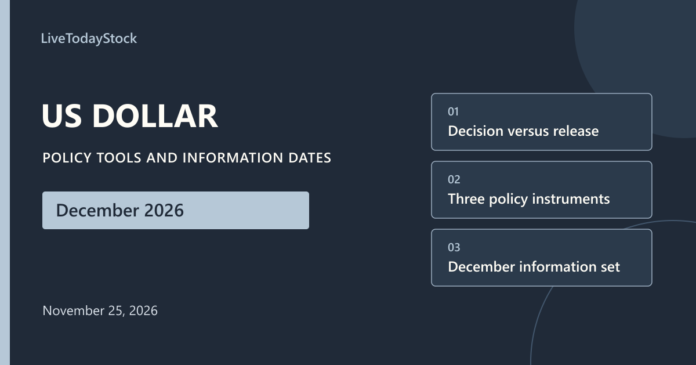

US dollar outlook research for December 2026 needs to distinguish a newly published document from a newly taken policy decision. Research cutoff: November 25, 2026. The Federal Reserve’s November 24 discount-rate release describes meetings held in October. Treating that publication as a November rate increase would create a false starting point for December.
This is research about US monetary-policy information and the dollar’s comparison currencies. It does not publish a current dollar-index level, a live currency quote or a December closing-price target. A trade-weighted index and a particular exchange-rate pair remain different measures; no proprietary index series is reproduced here.
A November publication can contain an October decision
The November 24 release covers the Board’s discount-rate meetings of October 19 and October 28. It explicitly distinguishes that process from the FOMC’s process for setting the federal funds target range. The attached minutes describe the October 28 approval and October 29 effective date. These are three different dates, not three policy changes.
| Date | What the document establishes | What it does not establish |
|---|---|---|
| October 28 | Approval of the specified policy implementation settings | A decision taken on November 24 |
| October 29 | Effective date for the federal funds range and reserve-balance rate described in the minutes | A future December setting |
| November 24 | Publication of the Board’s earlier discount-rate meeting record | A new FOMC meeting or an additional rate increase |
New information and a new instrument setting are different events. A later record can clarify the earlier process without changing the rate on its publication date. A currency explanation should identify which part of the information set changed, rather than attach every dated release to a new policy action.
Three dollar rates with different functions
The published minutes record the following October settings. The policy range is not itself a single traded overnight rate. Reserve remuneration and central-bank lending also serve different functions; neither is an offer available to every saver.
| Instrument | Recorded setting | Correct comparison |
|---|---|---|
| Federal funds target range | 3.75%–4.00% | A policy range; not a retail deposit yield |
| Interest on reserve balances | 3.90% | A rate on eligible reserve balances; not a bond’s total return |
| Primary credit rate | 4.00% | A discount-window lending rate; not another name for the whole target range |
The range is 0.25 percentage points wide, or 25 basis points. The reserve-balance rate is 10 basis points below its upper bound and 15 above its lower bound. These are our arithmetic comparisons of the specified instruments, not estimates of a bank customer’s spread, a December currency return or an executable trade.
A headline that describes all three as “the dollar interest rate” loses those distinctions. For an actual deposit, bond or currency contract, the relevant instrument has its own maturity, credit exposure, fees and terms. A policy number cannot replace those details.
The October vote supplies context, not a December promise
The separate October 28 FOMC statement kept the range unchanged by a 10–2 vote; the two dissenters preferred a quarter-point increase. An unchanged collective decision therefore does not mean every participant favored an unchanged rate. Conversely, dissent does not pre-announce the next decision.
For December, the research question is what subsequently changes the assessment of inflation, activity and appropriate policy. That requires new evidence. Without a verified, dated market expectation, this file does not label an eventual decision a surprise or assign a probability to a rate move.
Prepare for the next information set
The official calendar schedules December 8–9 and marks the meeting as associated with economic projections. The decision and projections are unknown at this cutoff. A participant’s projected path would also require its own definition and uncertainty; it would not become a binding exchange-rate path.
- Date the event: retain the meeting, effective and publication dates separately.
- Name the instrument: distinguish a target range, reserve remuneration and central-bank lending.
- Name the currency comparison: EUR/USD is dollars per euro; USD/JPY is yen per dollar, so a rise has different dollar-direction meanings.
- Record what changed: distinguish a new decision from an explanation of an earlier one.
The October dollar archive preceded these decisions. The forex guide covers broader market mechanics. This December worksheet concerns policy definitions and information timing, not a guaranteed return or personal trading instruction.